Article 15(5) of Regulation (EU) 2025/40 requires every item of packaging to bear a type, batch or serial number or equivalent element enabling its identification and traceability. European battery buyers are already writing this clause into supplier inquiries, often asking whether "cascaded traceability" across packaging levels is acceptable. This paper builds the traceability structure a nickel-metal hydride (NiMH) exporter needs from cell tray to export pallet.
Packaging placed on the EU market must carry an identifier allowing it to be linked to: the packaging type and material; the manufacturer or responsible operator; the production batch; and the technical documentation and Declaration of Conformity. The identifier may be a type code, batch/lot number or serial number — the regulation does not mandate serialisation of every carton, but it does require that any packaging item can be traced back to the compliant batch and file. Where size or material prevents direct marking, the information moves to accompanying documentation, but the link must remain reconstructable by a market-surveillance officer.
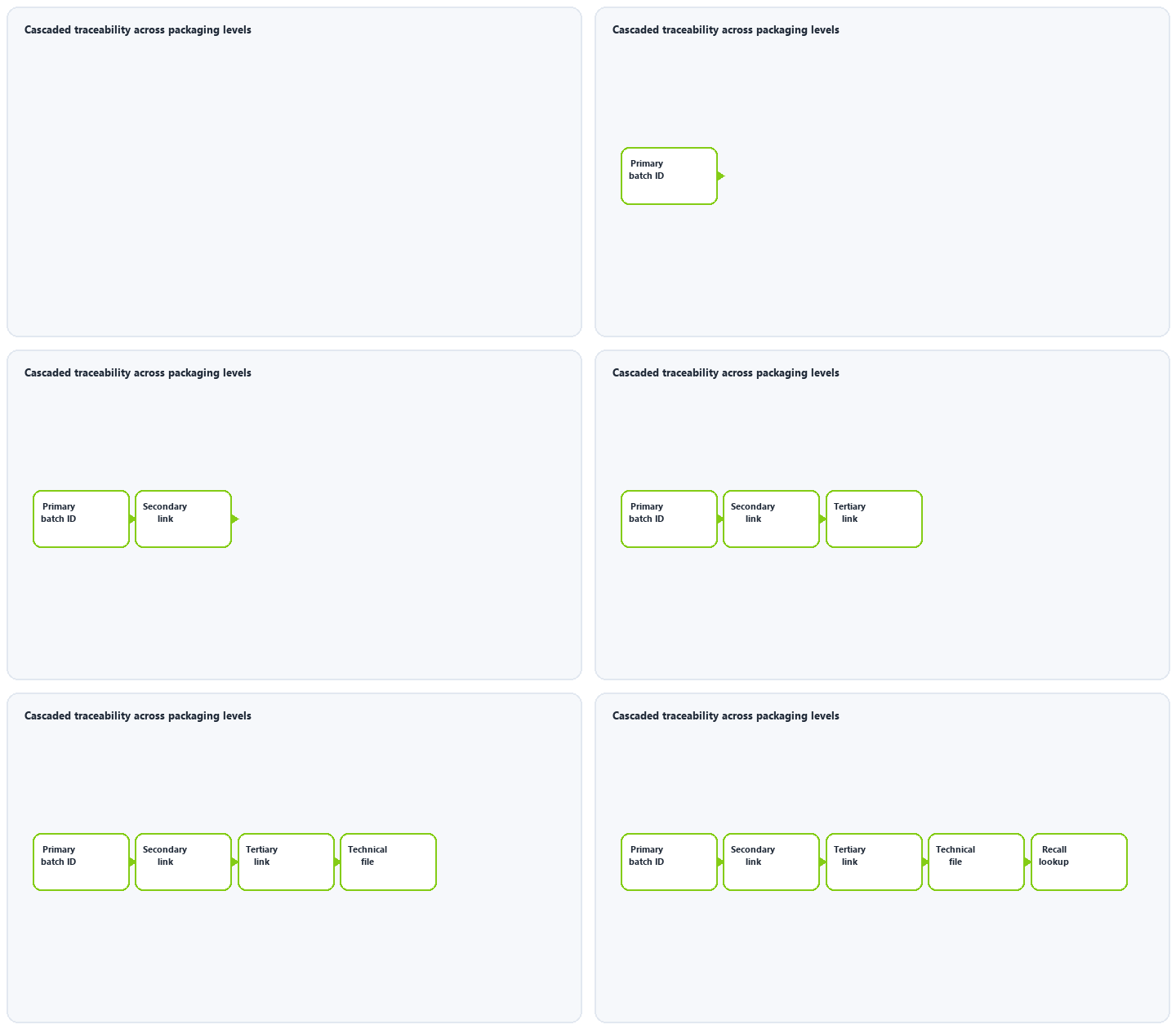
A cascaded (hierarchical) structure links identifiers across the three packaging levels rather than repeating full data on every item: the primary pack (cell tray or blister) carries a lot code tied to the cell production batch; the secondary inner carton label lists the primary lot codes it contains plus its own packaging batch; the tertiary export carton and pallet label aggregate the inner-carton identifiers and link to shipment documents. This satisfies operational traceability and recall containment — a defect can be isolated to one lot and its containing cartons. But European customers' inquiries correctly flag the boundary set by Article 39 and Annex VIII: cascaded linkage does not substitute for conformity assessment and a separate EU Declaration of Conformity for each packaging type. Hierarchy organises the identifiers; declarations still stand per level.
A workable code hierarchy combines product, material and batch: a packaging-type prefix identifying material and level (e.g. primary PET blister vs secondary corrugated box), a supplier/material lot, a production date code, and where customers require it, a unique serial for tertiary units. Human-readable text plus a Code-128 or Data Matrix symbol supports both warehouse scanning and authority inspection. The code must survive the supply chain — rub-resistant ink on cartons, durable labels on film-wrapped pallets — and remain legible at the point of sale for primary packaging. Master-data governance maps each code to its technical file, declaration and heavy-metal report so a code query returns the full compliance record.

Battery law already requires cell and pack batch traceability through the Annex VIII technical file and Article 13 manufacturing information. Aligning the two systems multiplies their value: the cell lot code, pack assembly lot, primary packaging lot and export carton serial share one database key, so a recall query — whether triggered by a cell defect or a packaging non-conformity — returns the complete containment tree within minutes. This is precisely the auditable linkage customers describe as "cascaded traceability", and it doubles as evidence under the GPSR-style operator-identification rules and market-surveillance requests.
Concrete steps: inventory packaging types per level and assign type codes; define lot-code rules and label artwork with material symbol; deploy scanning at packing so carton-to-lot links are captured automatically; store the hierarchy in the ERP with links to declarations and test reports; write a recall-and-containment procedure with mock-trace drills (target: full tree in under an hour); verify each packaging type still has its own Declaration of Conformity despite the shared hierarchy; and keep records for the regulatory retention period. Audit the system by sampling a finished pallet and reconstructing every identifier upward and downward.
Weijiang Power operates aligned battery-and-packaging lot traceability for its NiMH shipments: cell lot, pack assembly lot and primary/secondary/tertiary packaging codes linked in one record, scannable labels, mock-recall drills and separate Declarations of Conformity per packaging type. Share your coding standard or EDI requirements and we will map our lot hierarchy to yours so every carton on your dock resolves to its full PPWR and battery-law file.


