Marine equipment is approved against an international regulatory stack, and a reserve battery that supports distress communications or emergency lighting must be demonstrably compliant before the ship sails and verifiable at every survey thereafter. This final paper maps the type-approval and through-life assurance route for sealed nickel-metal hydride shipboard reserve modules. It begins with the treaty layer: SOLAS Chapter II-1 for the emergency source and transitional power (the 18/36-hour endurance and the loads that must be supplied), and Chapter IV regulation 13 for the independent radio reserve source, supported by the relevant IMO performance standards and the guidelines on the configuration of reserve sources used to supply GMDSS radio installations (which reference resolutions A.694(17) and A.702(17)), with flag-state implementations such as the US 47 CFR part 80 rules giving detailed capacity and charging requirements. It then maps the equipment and installation standards: IEC 60945 for the environmental protection and EMC of maritime navigation and radio equipment (and of reserve equipment in that environment), the IEC 60092 series for electrical installation on ships, and IEC 60533 for shipboard electromagnetic compatibility; equipment falling within the EU Marine Equipment Directive 2014/90/EU carries the wheel mark against the applicable MED performance standards. The battery itself carries IEC 61951-2 performance and IEC 62133-1 safety evidence; as a non-lithium chemistry, sealed NiMH is outside UN Manual of Tests and Criteria Section 38.3 and Class 9 for transport. The paper is explicit about scope boundaries - the survival-craft two-way VHF primary-battery requirement and EPIRB primaries are outside what rechargeable NiMH may replace - and it closes with the periodic survey, inspection and drill regime that proves the reserve remains ready, explaining how a supplier with complete, consistent sealed-NiMH evidence and an understanding of the marine approval process removes a recurrent class and flag-survey bottleneck.
SOLAS Chapter II-1 sets the emergency-source endurance and load list (18 hours cargo, 36 hours passenger, with the transitional source covering the generator start period), while Chapter IV regulation 13 mandates the independent radio reserve and its automatic connection and charging. IMO performance standards for GMDSS equipment and the guidelines on reserve-source configuration (referencing A.694(17) general requirements and A.702(17) radio equipment measures, and reflected in classification and flag rules) define how the reserve capacity is calculated and protected.
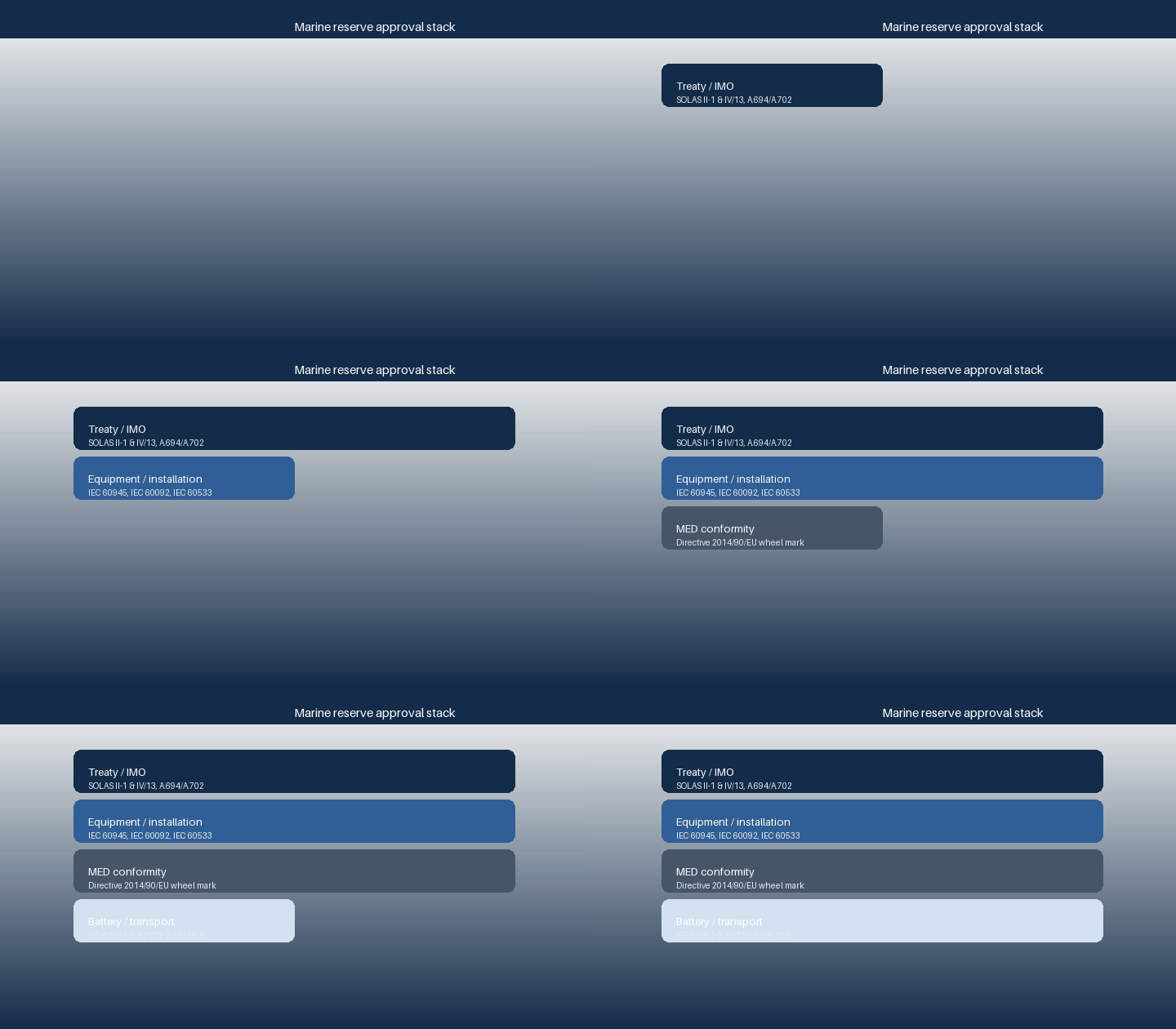
Flag administrations implement these internationally - for example US 47 CFR part 80 subpart W specifies the simultaneous radio loads, endurance and charging - and classification societies publish type-approval schemes. The first animated figure sequences the regulatory stack from SOLAS down to the cell certificate. The battery supplier must know precisely which function its module supports, because the emergency source, the radio reserve and the survival-craft radios are three different regulatory scopes.
The approval is only valid within its scope. Sealed NiMH modules may be approved for ship-installed reserve functions - the GMDSS radio reserve where the flag and class accept the chemistry, transitional sources, emergency-lighting and bridge/alarm backup - subject to meeting the endurance, environmental and charging requirements. They must not be marketed as replacing the primary batteries mandated for survival-craft two-way VHF radiotelephones installed after 23 November 1996, nor the long-standby primary cells in EPIRBs and certain survivor lights.
Maintaining this boundary in documentation and labelling protects the shipowner from a detention-causing deficiency and protects the supplier's credibility. The certification file states the served function, the regulated endurance, and an explicit exclusion where a primary battery is legally required. This honesty is itself valued by classification surveyors who routinely reject generic 'marine battery' claims that ignore the survival-craft rules.
IEC 60945 defines environmental and EMC requirements for maritime navigation and radio communication equipment, and reserve modules supporting such equipment are tested to the relevant classes: dry heat, damp heat, cold, thermal cycling, vibration, mechanical shock, corrosion resistance and (for exposed equipment) ingress, alongside EMC emissions and immunity including radiated RF, conducted RF, electrostatic discharge, electrical fast transient, surge and voltage variations.
Tests are performed on the complete charger-plus-battery module in its marine enclosure, at the supply voltages and in the charge/support modes used at sea. The passive NiMH pack contributes no switching noise; the charger and any inverter carry the EMC design effort, and the module must not introduce conducted disturbance onto the radio supply that could degrade GMDSS reception. The second animated figure maps environmental and EMC stresses to the pack.
The IEC 60092 series governs electrical installations in ships - rotating machines, switchgear, cables, transformers, lighting, batteries and installation practice - covering the battery space or enclosure, ventilation assessment, protection against short circuit and earth fault, cable sizing and segregation, and automatic connection arrangements. Because sealed NiMH evolves minimal gas under normal operation compared with flooded lead-acid or NiCd, the ventilation and battery-room burden can be reduced, but the installation assessment still follows the standard.
IEC 60533 sets electromagnetic compatibility for electrical and electronic installations on ships, complementing IEC 60945 at system level; the reserve installation is assessed for compatibility with navigation, radio and alarm systems in the actual electrical arrangement. MED-covered items are approved against the directive's listed performance standards and carry the wheel mark, with manufacturer module B (type examination) and module D/E/F (production conformity) conformity assessment as applicable.
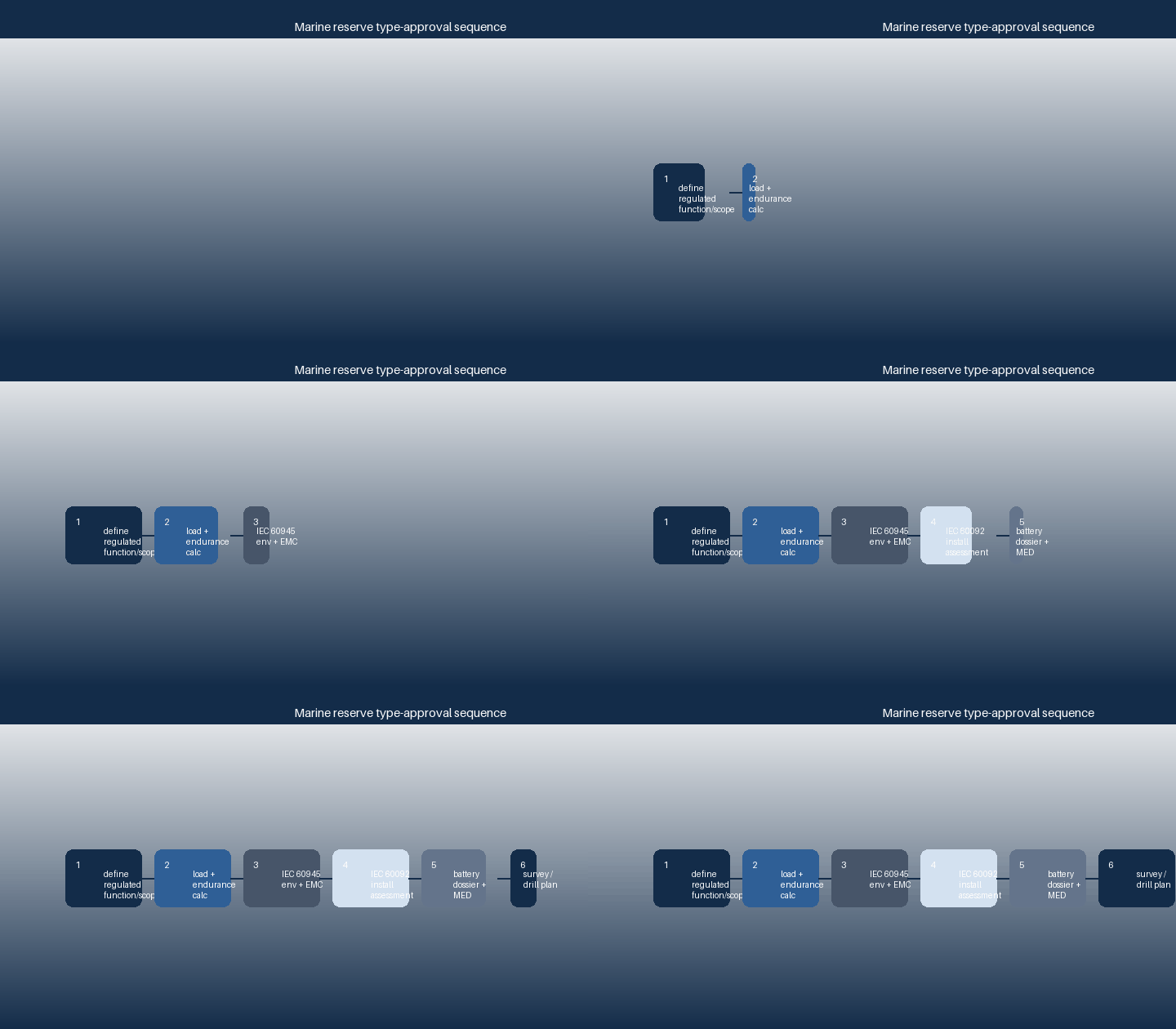
The cells and modules are supported by IEC 61951-2 (sealed NiMH performance: capacity, internal resistance, charge retention, endurance) and IEC 62133-1 (safety under intended use and foreseeable misuse); because sealed NiMH is non-lithium it is outside UN Manual Section 38.3 and Class 9, which makes it comparatively simple to ship as spares to vessels and ports. The marine dossier adds application evidence: the endurance discharge against the actual radio or lighting load at the regulated duration, transmit-peak voltage tests, cold and hot operation, charge-retention after the maximum idle interval, vibration/heel and salt-mist results, and the automatic-transfer and alarm logic.
Construction and lot traceability are documented so replacement packs remain within the approved type; marine approval demands consistency because a survey verifies that installed equipment matches the type-tested design. The charger's float profile and its compatibility with sealed NiMH is included, since an unsuitable charger is the most common cause of reserve-battery degradation in service.
Approval continues after delivery. SOLAS and flag/class rules require periodic inspections and tests of emergency and reserve sources - visual and terminal checks, battery condition and electrolyte where applicable, charger and alarm checks, and discharge/endurance tests at intervals - alongside emergency drills in which the reserve is exercised. Sealed NiMH reduces the electrolyte workload but the operational tests still apply, and the supervision/self-test outputs of a modern module make the evidence easier to record.
The acceptance package for the owner therefore includes the type-approval certificates, installation and connection drawings, the load/endurance calculation, maintenance and test procedures, and spares traceability. A supplier that provides construction-stable sealed NiMH cells with complete IEC 61951-2 and IEC 62133-1 evidence, marine-environmental test support and clear scope guidance gives shipyards and owners a defensible, lower-maintenance reserve for the long emergency night and the critical distress hour - without overstepping the legal boundary where primary batteries remain mandatory.
Weijiang Power designs and manufactures sealed nickel-metal hydride cells and matched industrial packs for remote, off-grid and safety-related equipment, and supports OEM partners with IEC 61951-2 performance files, IEC 62133-1 safety evidence, pulse-load characterisation, wide-temperature testing and charger/pack co-validation. Tell us your duty cycle, peak current, temperature envelope, autonomy target and the standards your product must meet, and our engineers will specify a cell-and-pack combination that protects runtime, reliability and service life. Review the range on the products page.


