Sizing backup for platform screen doors and fare gates starts from a different question than conventional UPS design: not 'how long can we run the load' but 'what must happen in the first seconds and minutes of an emergency, and what energy makes that action certain at end of life'. This paper develops sealed nickel-metal hydride backup modules for PSD local door controllers and AFC gate pillars from that fail-safe premise. It defines the emergency energy budget as a sequence - detect the power loss, release or drive the barrier through a defined number of open/close cycles or hold an evacuation configuration, maintain indicators and the emergency egress logic, and on gates complete the current transaction and flush the audit log - then converts that sequence into a delivered capacity at the worst station temperature and after years of float. It checks pulse current separately, because a door motor or flap mechanism stalling on cold, high-resistance cells would defeat the entire safety concept even with ample total energy. The paper sets out the 24 V safety-voltage architecture typical of gate and door controls, the temperature-compensated charge regime that keeps sealed cells healthy during long standby, and the supervision and periodic self-test that prove readiness. It then compares sealed NiMH candidly with the alternatives a transit integrator will consider: valve-regulated lead-acid (cheap but cold-weak, heavy and float-life limited), lithium-ion (compact but requiring a BMS and a stronger thermal/fire case in an egress path), and capacitors or purely mechanical fail-open (instant and robust for one release but unable to power controlled cycles, logic or data save). The conclusion is a layered design in which mechanical fail-safe guarantees the egress path regardless of battery state, while sealed NiMH provides the controlled cycles, indication and data protection that make evacuation orderly.
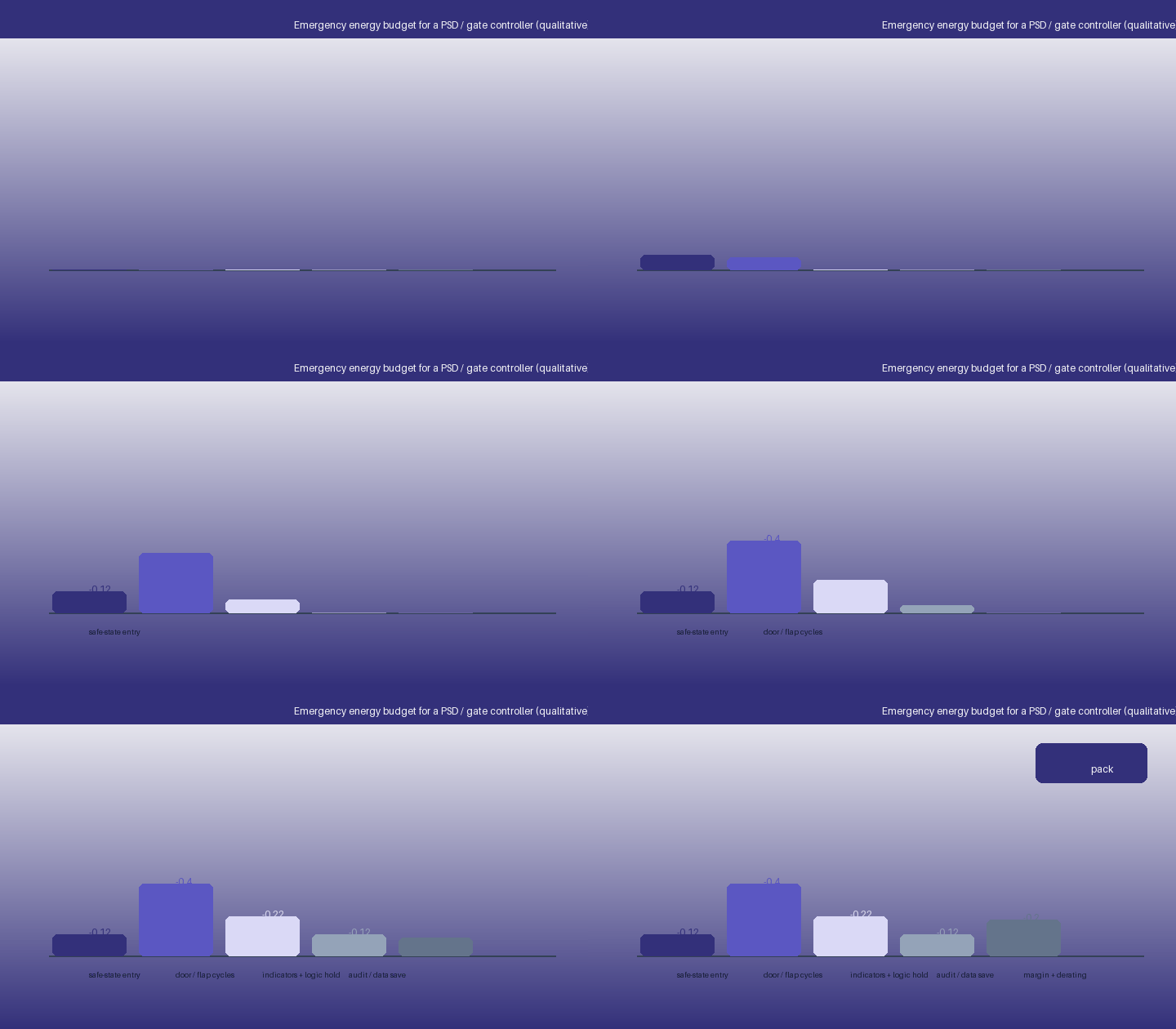
The budget is built action by action. For a PSD local controller it includes detection and safe-state entry, a specified number of powered open/close cycles (or holding doors open) to allow managed evacuation, indicator and alarm operation, and communication of status to the station controller. For an AFC gate it includes barrier release, completion or rollback of the transaction in the lane, writing the entry/exit and revenue audit records, and a period of indication or reduced service. Each action has an energy and a peak-current value taken from the actual mechanism and controller.
The first animated figure stacks these contributions. As with signalling backup, the nameplate capacity is obtained only after derating for minimum station temperature, end-of-life fade, the usable voltage window and a safety margin; the difference between the raw sum and the specified pack is substantial and must be documented for the safety case.
Door and flap mechanisms are motor loads with a high starting current and a possible mechanical overload if a panel is obstructed or cold-stiffened. The pack must deliver the worst simultaneous pulse - for example several local doors releasing together, or a gate flap retracting while the controller and indicators are active - without the terminal voltage falling below the drive or logic cut-out. Cell internal resistance at low temperature and state of charge sets this margin, so low-resistance industrial cells and adequate string sizing are essential.
The design verifies the pulse at the cold credible condition and after the defined standby interval, not only at room temperature fresh. Sealed NiMH's flat discharge characteristic keeps the motor voltage predictable across most of the capacity, which simplifies the drive's low-voltage behaviour and avoids the steep brown-out region of lead-acid; this predictability is valuable when a safety action must complete in seconds.
Gate and door control electronics commonly operate on a 24 V SELV bus with residual-current protection for passenger safety, and the backup module is arranged on this bus through isolation and OR-ing so it supports the local controller without back-feeding the station network. A current-limited, temperature-compensated charger maintains the sealed NiMH pack during normal station operation using a profile appropriate to long float, avoiding the overcharge that would dry or age sealed cells.
Low-self-discharge cells and a sound charge regime let the module sit for months between tests yet deliver full emergency energy. Local fusing and per-string protection contain a short in a mechanism exposed to dust, moisture and vibration, and the module is packaged to meet the enclosure's ingress rating and the under-platform or in-pillar thermal environment.
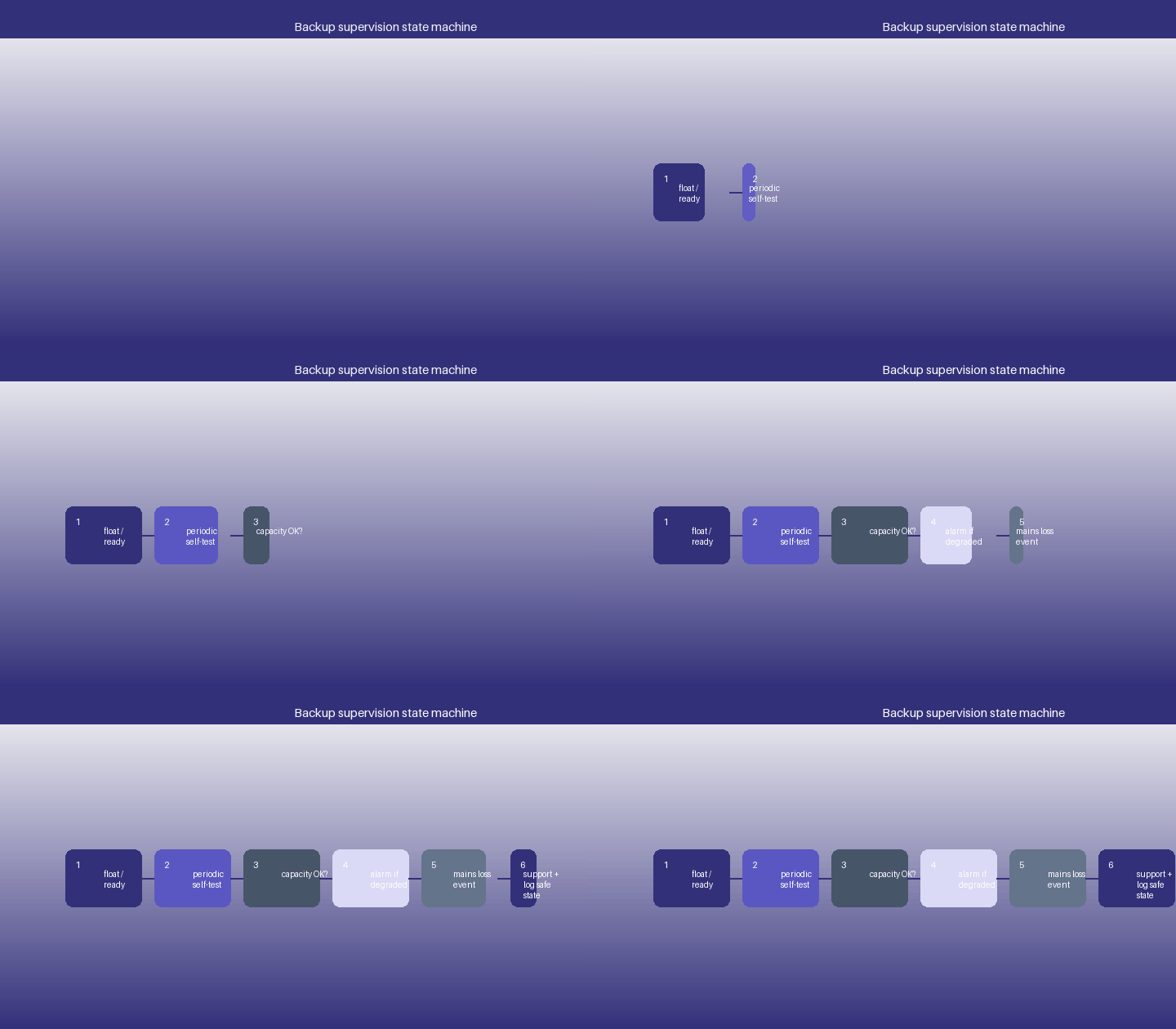
Because the battery works only in a rare emergency, its failure would otherwise be silent. The controller monitors pack voltage, temperature and charge state, performs periodic automated or scheduled self-tests (including, at defined intervals, a controlled pulse or partial discharge that verifies internal resistance and available energy), and raises a maintenance alarm before capability falls below the requirement. Every mains-loss event and emergency action is logged with timestamp and duration, correlating with station SCADA records.
This readiness data feeds the station's maintenance regime and the safety demonstration: the operator can show not merely that batteries were installed but that each barrier's backup was capable at the time of any incident. The second animated figure shows the supervision state machine from float and self-test through alarm and emergency support.
VRLA lead-acid is the incumbent cheap option but its weaknesses are exposed in distributed door and gate pillars: heavy packs, sharply reduced cold capacity, limited float life in warm under-platform cabinets through grid corrosion and dry-out, and acid that must not leak into a passenger egress path. Replacement across hundreds of lanes and door units becomes a recurring maintenance burden.
Lithium-ion is compact and high-voltage but mandates cell balancing and protection electronics and requires a careful thermal and fire-safety case for equipment embedded in an evacuation route; the added BMS complexity is hard to justify for a small module whose entire job is a rare, short, conservative action. Sealed NiMH avoids both the lead-acid servicing and cold weakness and the lithium management and thermal complexity, sitting in a robust middle ground for safety-related standby.
Supercapacitors and spring/gravity mechanisms excel at a single, instant, temperature-insensitive release and are correctly used as the ultimate fail-safe for barrier opening; they cannot, however, power repeated controlled cycles, maintain indicators and logic for minutes, or save and hold audit data. The robust architecture is therefore layered: a mechanical or capacitive fail-safe guarantees the egress path opens even if all electronics and batteries are dead, while a sealed NiMH module provides the controlled, observable, data-preserving behaviour above that floor.
This division of responsibility is exactly what ISO 18298's emergency doors and trackside egress devices and EN 14752's per-door egress device imply - manual, unconditional escape is always available, with powered backup adding orderly management. The qualification paper that follows sets out the functional-safety, cycle, environmental and battery evidence needed to demonstrate the complete layered system to a transit authority.
Weijiang Power designs and manufactures sealed nickel-metal hydride cells and matched industrial packs for remote, off-grid and safety-related equipment, and supports OEM partners with IEC 61951-2 performance files, IEC 62133-2 safety evidence, pulse-load characterisation, wide-temperature testing and charger/pack co-validation. Tell us your duty cycle, peak current, temperature envelope, autonomy target and the standards your product must meet, and our engineers will specify a cell-and-pack combination that protects runtime, reliability and service life. Review the range on the products page.


