A hospital ward never sleeps, and neither does its nurse station. Workstations, the nurse-call master station, label and wristband printers, bedside-monitor gateways and the PoE switch that feeds them all share a quiet dependency on clean, uninterrupted power. When the public supply dips or drops, a small local uninterruptible power supply (UPS) does not need to carry the ward for hours; it needs to bridge seconds to minutes until the automatic transfer switch (ATS) closes on the second feeder or the standby generator starts and stabilises. Paper A dissects that short-bridge load, places it against the IEC 62040 UPS classification and the IEC 60364-7-710 medical-location installation rules, and explains why a well-chosen nickel-metal hydride (NiMH) pack is unusually well matched to it.
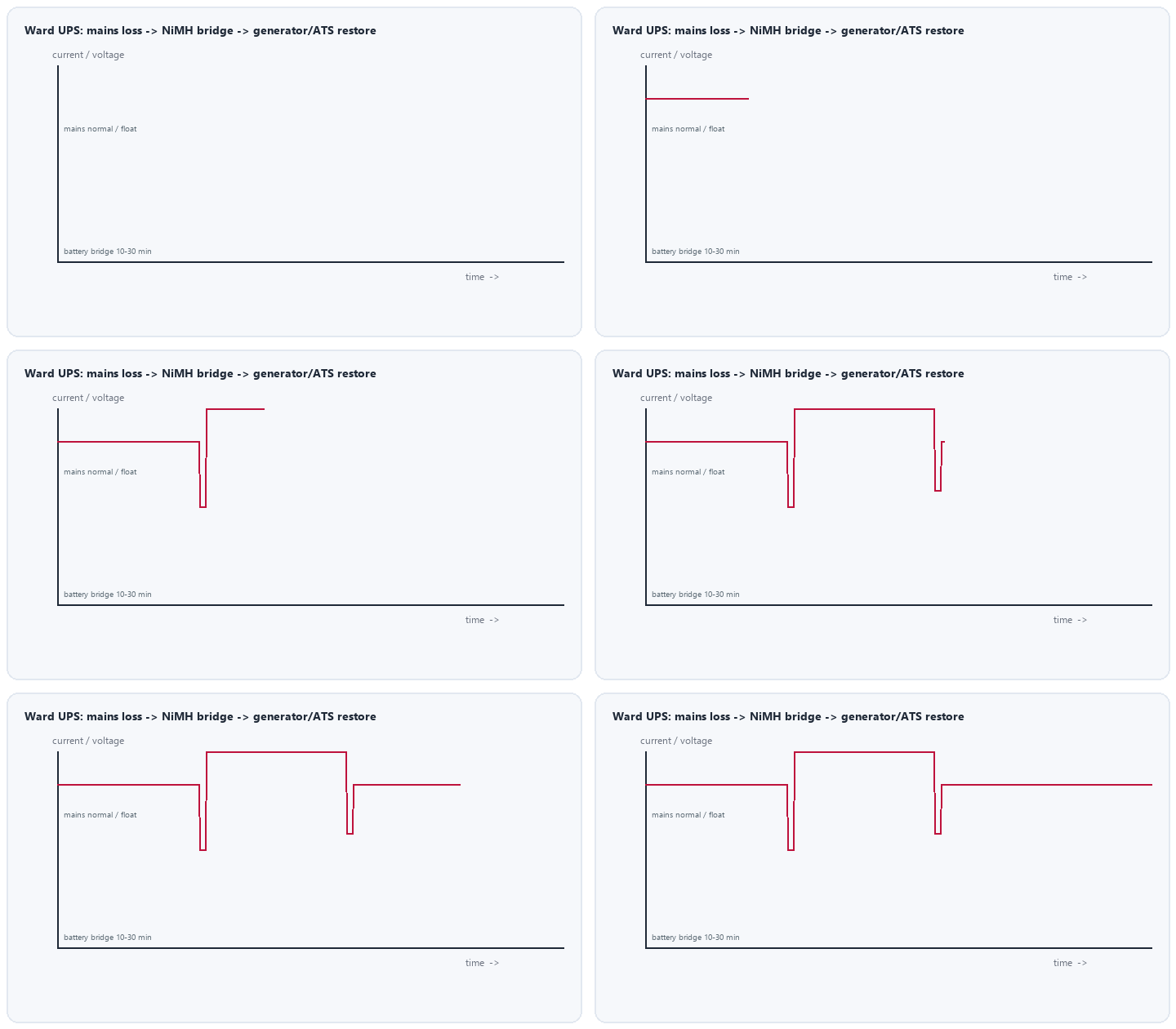
The first principle of backup sizing is that the protected load is not the nameplate sum of every device but the duty-weighted current they draw together. A modern nurse station mixes three load classes. Continuous base load comes from thin-client or all-in-one workstations (typically 25-65 W each), the nurse-call master and its IP gateway (5-20 W), network switches with PoE for corridor panels and room modules (15-60 W plus PoE bursts), and monitor data aggregators. Intermittent load comes from thermal or laser label printers, wristband printers, barcode scanners in their docks and charting tablets charging in a rack; a laser printer can pull 300-700 W for a few seconds during fusing, a transient the UPS inverter must ride through without dropping output. Inrush load appears when multiple switch-mode supplies start together after a transfer. The animated trace below separates the long flat floor from the short bursts that actually set the inverter and battery rating.
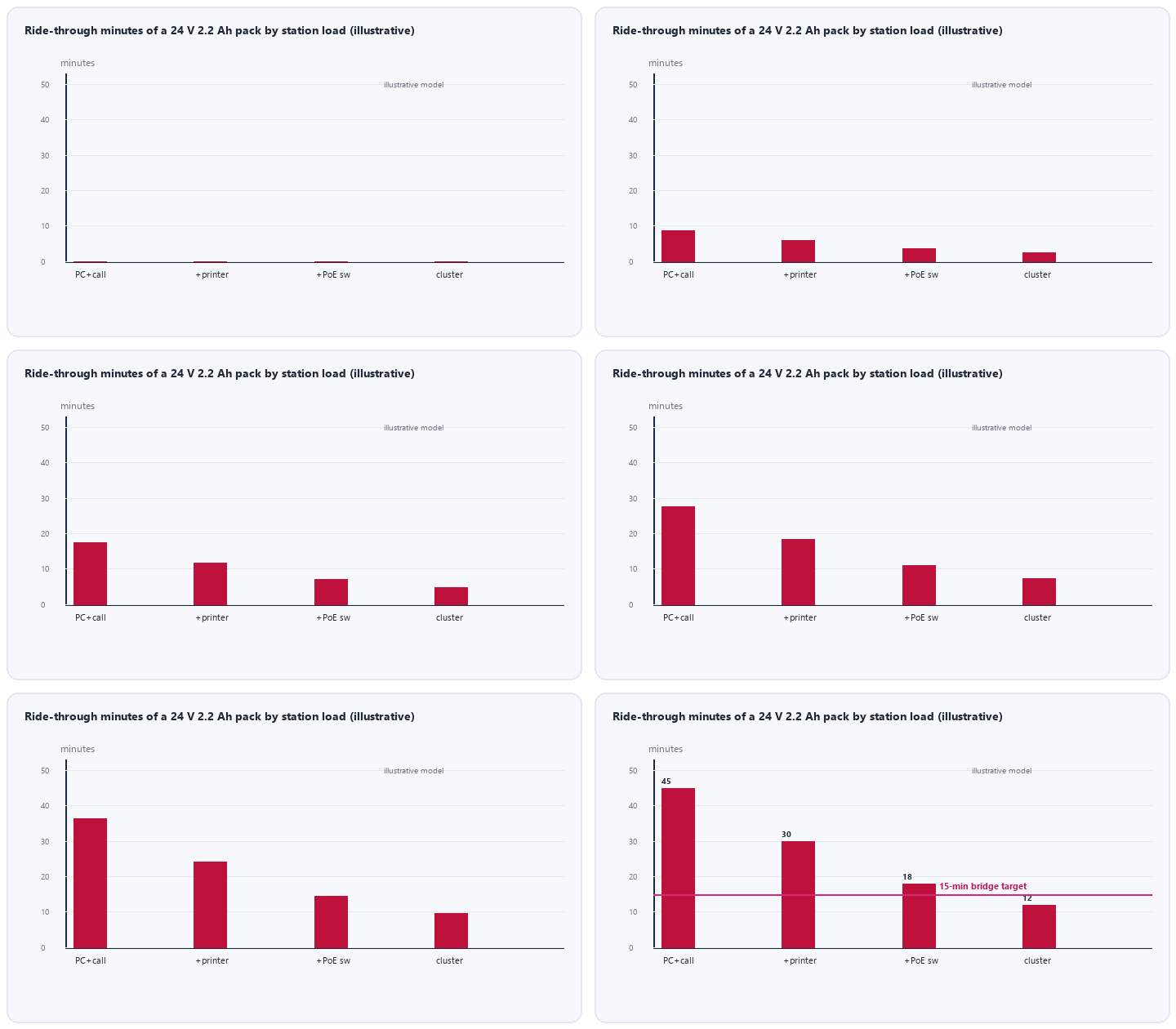
Hospital electrical design is layered. IEC 60364-7-710 classifies medical locations into groups 0, 1 and 2 according to the role of electrical equipment in patient safety, and it distinguishes between the safety supply, which must be available within defined switchover times, and the longer-duration standby source. In Chinese design practice, JGJ 312-2013 (the medical-building electrical design code) puts operating rooms, rescue rooms and ICU on online double-conversion UPS with effectively zero transfer time, commonly using the UPS as a 15-30 minute bridge to a diesel generator that starts and accepts load within roughly 15-30 seconds. General wards and nurse stations sit at the lighter end of this hierarchy: a local UPS is sized to keep the nurse-call master, charting workstations and the local switch alive through brief outages and across the generator-start window, typically 10-30 minutes rather than the multi-hour autonomy expected of a data-centre UPS. The animated chart below shows how the same fixed pack delivers different bridge times as station load grows; the numbers are an illustrative engineering model, and a real project must be built from a measured load survey.
IEC 62040-3 classifies UPS output behaviour into three performance types. A voltage-and-frequency-independent (VFI, double-conversion) UPS continuously regenerates the output through rectifier and inverter, so the load sees no transfer gap at all and is isolated from mains disturbances; it is the topology mandated for the most sensitive clinical areas. A voltage-independent (VI, line-interactive) UPS conditions the supply and switches to inverter on failure within a few milliseconds, which is perfectly adequate for nurse-station IT and nurse-call hardware whose internal DC-link capacitors bridge the gap. A voltage- and-frequency-dependent (VFD, offline) UPS offers the lowest cost but a perceptible transfer and is best reserved for non-safety office loads. For a ward station the engineering choice is usually VI at the local level, fed upstream by a building VFI chain where the safety case requires it. The battery inside sees the same essential duty in every topology: long periods at full charge at warm room temperature, punctuated by rare, short, high-value discharges.
A nurse-station UPS battery spends more than 99.9 percent of its life fully charged and almost no time cycling. That float-dominated profile punishes chemistries in different ways. Valve-regulated lead-acid (VRLA) blocks are cheap and familiar, but their float life collapses as temperature rises - the familiar rule of thumb that sustained operation 10 °C above 25 °C roughly halves service life - and a UPS tucked under a counter or above a suspended ceiling is rarely at 25 °C. Lithium packs offer light weight and long cycle life but add protection electronics and cost that a 15-minute bridge rarely repays. NiMH occupies a useful middle position: an aqueous alkaline chemistry with no thermal-runaway mechanism, tolerance of continuous readiness charging when the charge voltage is temperature-managed, better high-rate delivery per unit mass than VRLA, and none of the memory behaviour that discredited its nickel-cadmium predecessor. Paper B develops the ampere-hour budget and the chemistry comparison quantitatively.
Several standards converge on the nurse station. IEC 62040-1 governs UPS safety and IEC 62040-3 its performance classification and test methods; IEC 60364-7-710 governs wiring in medical locations, including IT isolated systems in group-2 rooms; IEC 60601-1-8 governs medical electrical alarm systems, which matters because a nurse-call or monitor-alarm silence caused by a power gap is itself a patient-safety event; and the cells inside an OEM pack fall under IEC 61951-2 for portable sealed nickel-metal hydride cells, IEC 62133-1 for sealed nickel-cell safety and UN 38.3 for transport. Designing the bridge means keeping the alarm chain alive first and the convenience hardware second. Paper C builds the complete evidence stack and test trail.
Weijiang Power manufactures industrial NiMH cells and welded custom packs for ward-level UPS and backup modules: matched low-resistance strings for printer-inrush transients, temperature-compensated float-charge design for warm ceiling and counter installations, and IEC 61951-2, IEC 62133-1 and UN 38.3 documentation. Send us your station load list with measured base watts, the worst printer or PoE transient, the required bridge time and the ambient at the mounting point, and we will size a pack that keeps the nurse-call and alarm chain alive until the generator closes.


