Where wayside signalling backs up the track, onboard train control backs up the authority under which a train is permitted to move. Inside the cab and the equipment cubicle sit the European Vital Computer (EVC) that supervises braking curves and movement authorities, the Balise Transmission Module (BTM) and antenna that read Eurobalise telegrams, the Driver-Machine Interface (DMI) that displays speed and authority, the Juridical Recording Unit (JRU) that logs the train's safety history, and the GSM-R data radio that exchanges information with the Radio Block Centre in ETCS Level 2. This paper explains the working principle and load profile of the power that must keep this chain alive when the train's normal supply is disturbed. Unlike a stationary UPS, onboard backup lives in one of the harshest environments in electronics: EN 50155 defines the equipment's nominal battery bus voltages (commonly 24, 36, 48, 72 and 110 V), its operating temperature classes from -25/-40 degrees C to +55/+70/+85 degrees C, a start-up requirement down to -40 and up to +85 degrees C for at least ten minutes, and shock and vibration referenced to EN 61373. The train battery feeds an auxiliary DC bus through converters, and local hold-up or backup modules must bridge supply interruptions, support a controlled shutdown that preserves the JRU record and the current movement authority, and - on critical functions - maintain vigilance and emergency communication long enough to bring the train to a safe state. The paper develops the characteristic duty: a steady vital-computer and radio baseline, periodic BTM bursts as balises are passed, DMI backlight and audio peaks, and the requirement to ride through the supply interruptions and brown-outs that EN 50155 and the vehicle's power architecture define. It introduces the dedicated railway battery standard IEC 62973, whose Part 4 covers secondary sealed nickel-metal hydride cells for rolling-stock auxiliary power, and sets up the selection and qualification treated in the following papers.
The EVC is the safety core: it fuses balise position references, odometry, GSM-R movement authorities and train data to supervise speed and command braking if the driver exceeds the permitted envelope. The BTM energises and reads balises through the under-floor antenna; the DMI renders the braking curve, target speed, indications and alarms; the JRU continuously records safety-relevant data for post-event analysis; and the GSM-R radio maintains the circuit- or packet-switched link to the block centre. Each has a different current signature but all share one property - an uncontrolled loss of power during a run is itself a safety event.
The train's auxiliary battery bus is the primary reservoir, typically nominal 110 V or 72 V on mainline stock and 24/48 V on metros and trams, with DC-DC converters deriving the logic rails. Local backup and hold-up modules sit between the bus and the vital electronics to smooth interruptions and, where required, sustain defined functions after the bus is lost. Sizing that backup begins with an accurate load profile of the complete chain rather than the nameplate wattage of any single box.

EN 50155 is the reference for electronic equipment on rolling stock and it drives every power decision. It defines nominal supply voltages and the interruptions, dips and surges the equipment must tolerate, six operating-temperature classes (OT1 to OT6, from -25 or -40 degrees C up to +55, +70 or +85 degrees C body temperature), storage classes, and a start-up capability from -40 to +85 degrees C for at least ten minutes. Equipment near heat sources or in unventilated cubicles can see the higher classes, while under-floor and external equipment sees the coldest.
Shock and vibration are referenced to EN 61373 (equipment is assigned a category and class, with Category 1 Class B a common default), EMC to the EN 50121 series, and fire behaviour increasingly to EN 45545. A sealed NiMH backup pack must therefore deliver its hold-up energy after cold soak, survive sustained broadband vibration without internal connection fatigue, use low-fire-load materials, and not emit gas or leak electrolyte in a sealed cubicle - requirements that rule out casual use of consumer cells or flooded chemistries.
Onboard backup is not a single duration but a hierarchy of duties. At the shortest scale, hold-up capacitors and small battery modules bridge supply interruptions and changeover gaps (milliseconds to seconds) so the EVC never resets during neutral sections, pantograph bounce or converter switchover. At the medium scale, the backup supports an orderly shutdown - finishing the JRU write, saving state and movement-authority context, and parking the DMI - so the system restarts deterministically rather than forcing a lengthy, capacity-consuming reinitialisation.
At the longest scale, selected safety and communication functions (vigilance, emergency lighting and command circuits, the GSM-R radio for a defined call) may be sustained to allow the driver to communicate and bring the train to a safe state before evacuation. The first animated figure shows this tiered timeline against falling bus voltage: ride-through, ordered shutdown and, where specified, extended emergency support. Each tier maps to a different energy and power requirement, and confusing them - over-sizing for ride-through or under-sizing for shutdown - is a common design error.
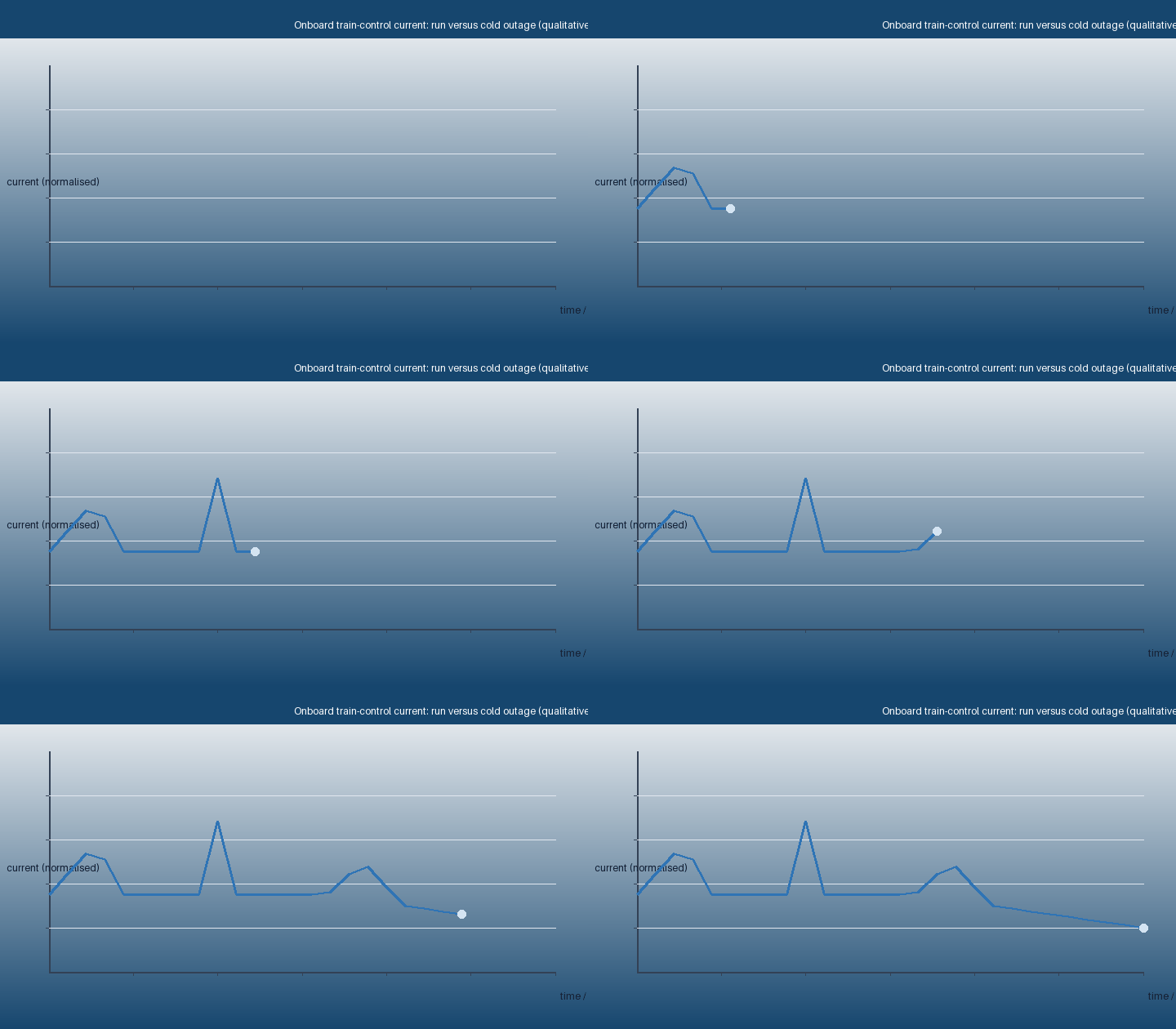
Measured across a run, the onboard chain draws a near-constant vital core (EVC, JRU, radio standby, BTM receiver) with superimposed peaks: the BTM transmit burst energising each balise, GSM-R transmit bursts during handover and call setup, DMI backlight and audio annunciation, and relay or valve actuation when an emergency brake command is issued. The backup must hold the logic rail through the highest credible simultaneous peak at low temperature, when internal resistance is greatest and voltage sag deepest.
The second animated figure contrasts a normal run with a cold, degraded-bus event. Sealed NiMH's flat voltage plateau and good pulse behaviour suit this mixed profile, and its chemistry tolerates the shallow, infrequent discharge and long float/standby that onboard backup actually sees - the pack spends almost all its life charged and waiting, and only infrequently delivers energy, so charge retention and float stability matter more than deep-cycle energy density.
Rolling-stock auxiliary batteries have historically been vented nickel-cadmium for its extreme robustness, with lead-acid in some stock and lithium-ion emerging. The IEC 62973 series now structures qualification by chemistry: Part 1 gives general requirements and tests for auxiliary batteries, Part 2 covers NiCd, Part 3 lead-acid, Part 4 secondary sealed nickel-metal hydride, and Part 5 lithium-ion. The existence of a dedicated sealed-NiMH part gives designers a railway-recognised route for a sealed, maintenance-reduced chemistry on the vehicle.
Sealed NiMH is particularly suited to distributed and local backup modules - at the EVC rack, the BTM cubicle or the DMI/radio - rather than to replacing the entire high-capacity traction-auxiliary bank. It removes watering and free electrolyte, carries no cadmium, tolerates the shallow float duty and cold environment well, and can be packaged close to the electronics it protects. The next paper sizes these modules and compares chemistries under EN 50155.
The consolidated requirement is for a sealed, vibration-rated NiMH module sized across the three duty tiers, connected through a charger and isolation that respect the nominal bus and its interruptions, supervised for state and health, and qualified to the temperature class, EN 61373 mechanical levels, EN 50121 EMC and EN 45545 fire behaviour of the mounting location. Its cells and construction must be traceable to IEC 62973-4 and the underlying cell performance and safety standards.
The following papers deliver the hardware and the evidence: the second sizes the pack, selects the charger and compares NiMH with NiCd, lead-acid and lithium under rolling-stock constraints; the third maps the EN 50155 type-test and safety-integration campaign, including cold start, vibration, EMC, fire and the railway battery dossier that an OEM or signalling supplier must present for approval.
Weijiang Power designs and manufactures sealed nickel-metal hydride cells and matched industrial packs for remote, off-grid and safety-related equipment, and supports OEM partners with IEC 61951-2 performance files, IEC 62133-2 safety evidence, pulse-load characterisation, wide-temperature testing and charger/pack co-validation. Tell us your duty cycle, peak current, temperature envelope, autonomy target and the standards your product must meet, and our engineers will specify a cell-and-pack combination that protects runtime, reliability and service life. Review the range on the products page.


