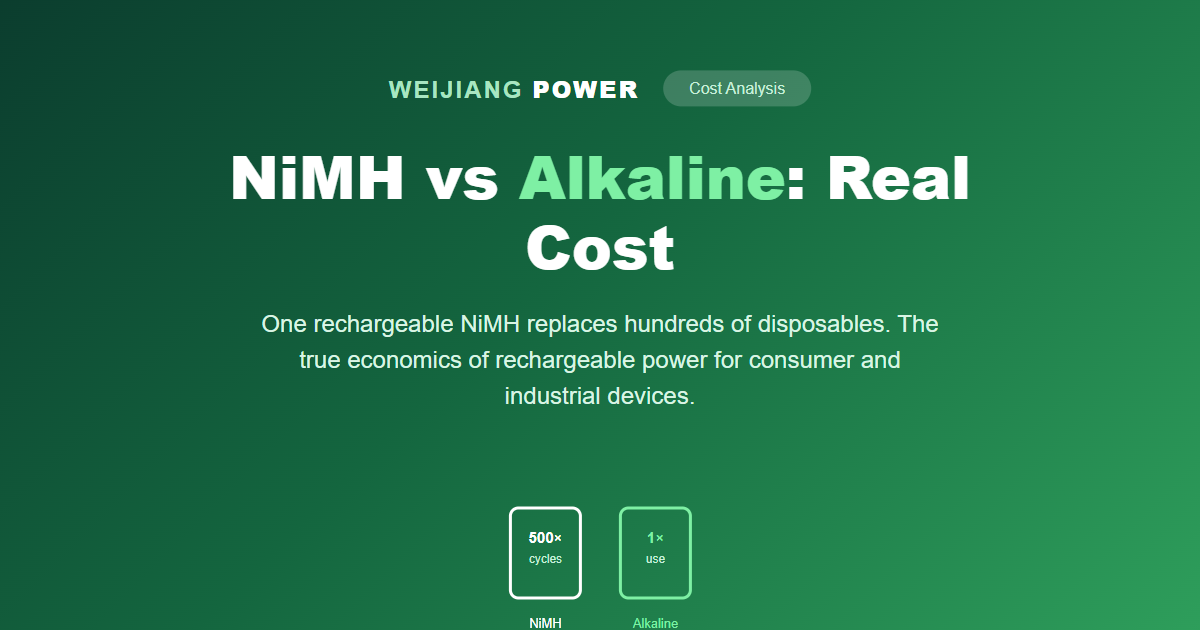
One alkaline cell costs less than one NiMH cell — but a rechargeable NiMH replaces hundreds of disposables. The real economics and when each makes sense.
The Price Tag That Misleads
Walk into any store and a pack of AA alkaline cells costs less than a single rechargeable NiMH cell. The comparison seems decisive — until you count how many alkaline cells one NiMH cell replaces over its working life. This article lays out the real economics of disposable versus rechargeable power, the performance differences that matter in practice, and when it genuinely makes sense to switch.
The Basic Numbers
A typical quality NiMH AA cell is rated for roughly 500 to over 1000 charge/discharge cycles (more with good care and moderate rates). Each cycle replaces one set of alkaline cells. Even a conservative 500-cycle life means one NiMH cell replaces 500 alkaline cells. If an alkaline AA costs a fraction of a NiMH AA, the arithmetic still strongly favors NiMH over the battery's life — often by an order of magnitude or more in cost per delivered watt-hour.
- Cost per cycle — NiMH's purchase price divided by 500+ cycles is a fraction of a penny; alkaline's is its full price, spent once.
- Cost per delivered Wh — over life, rechargeable NiMH typically costs a small fraction of alkaline per watt-hour delivered.
- Total lifetime cost — a device that runs on 4 AA cells, cycled weekly, can save the cost of hundreds of disposables over a few years.
Where Alkaline Still Wins
Alkaline is not obsolete. It retains real advantages that keep it the right choice in specific cases:
- Very low upfront cost — for a device used rarely or discarded quickly, disposables may be cheapest in practice.
- Zero self-discharge over long idle — alkaline stores well for years; a NiMH left untouched loses charge over time unless it is LSD-grade.
- High initial voltage — alkaline starts near 1.5V and sustains a flat discharge; some devices are tuned to that profile.
- No charger needed — for casual users, buying disposables avoids the charger investment.
- Single-use simplicity — in low-drain devices that are rarely changed (wall clocks, remote controls), disposables can be pragmatic.
Where NiMH Clearly Wins
Rechargeable NiMH dominates whenever a device is used regularly:
- High-drain devices — digital cameras, flashlights, wireless mics, toys and tools draw current that alkaline handles poorly; NiMH delivers higher sustained current with less voltage sag.
- Frequent use — anything cycled daily or weekly is a textbook NiMH application.
- Devices that need stable voltage — NiMH holds a flatter discharge curve under load than alkaline, reducing cutout and brownout.
- Environmental / waste reduction — one rechargeable replaces hundreds of disposables, cutting hazardous waste and resource use dramatically.
- LSD variants — low-self-discharge NiMH holds 80%+ charge for a year, closing most of the idle-storage gap versus alkaline.
Performance Compared in Real Use
- Voltage profile — alkaline starts ~1.5V and falls steadily under load; NiMH sits near 1.2V but holds voltage flat, so high-drain devices actually run more consistently on NiMH.
- Discharge current — NiMH sustains high C-rates with far less sag; a high-drain device that dims or cuts out on alkaline runs fine on NiMH.
- Self-discharge — standard NiMH loses charge over months; LSD NiMH approaches alkaline's shelf life for standby use.
- Temperature — both operate in a wide range; NiMH handles repeated cold use better than alkaline, which loses efficiency in the cold.
The Hybrid Answer: When Devices Ship With Batteries
For OEMs shipping consumer or industrial devices, the choice is often about what to include in the box:
- Include disposables — lowest bill-of-materials, but customers then buy hundreds of disposables over the device's life and create waste.
- Include pre-charged LSD NiMH — slightly higher cost now, but the customer gets a rechargeable solution that is ready out of the box (LSD ships pre-charged) and saves them money and waste for years.
- Design for rechargeable — many devices, especially high-drain or frequently used ones, are better engineered around a NiMH cell's flat voltage and rechargeability.
For high-drain or high-usage products, shipping with LSD NiMH is often the best customer experience and the best sustainability story — an easy win for brands under ESG pressure.
Environmental and Supply-Chain Angle
The environmental math is stark: replacing hundreds of single-use alkaline cells with one rechargeable NiMH reduces raw-material extraction, manufacturing energy, packaging waste and disposal burden. Alkaline cells should be recycled, but recycling rates remain low, meaning many end in landfill. NiMH's established recycling loop recovers nickel and rare earths, closing the material cycle. Regulators increasingly reward designs that cut single-use battery waste — another reason rechargeable NiMH is a forward-looking choice.
Decision Guide for Buyers and Designers
- Device used weekly or more → choose NiMH (prefer LSD for infrequent-use devices).
- High-drain device → choose NiMH regardless of use frequency.
- Rarely used, low-drain, long shelf life needed → alkaline may be pragmatic, though LSD NiMH also works.
- Waste/sustainability goals → prefer rechargeable NiMH.
- Box contents for a new product → consider pre-charged LSD NiMH for customer satisfaction and ESG.
Weijiang Power Rechargeable Solutions
Weijiang Power manufactures standard, LSD, high-rate and wide-temperature NiMH cells and packs, including pre-charged LSD options ideal for OEM box contents. Our engineers can help you compare total cost and pick the right cell for your device — disposables are rarely the best long-term answer.
Series · NiMH Engineering Deep-Dives
Related Reading


