A buyer's guide to NiMH datasheets: rated vs real capacity, discharge curves, internal resistance, self-discharge and cycle life, and how to match specs to your application.

The Datasheet Is a Contract — Read It Like One
A NiMH datasheet is the supplier's promise about how a cell behaves. Read carefully, it tells you whether a cell suits your product; read carelessly, it hides exactly the numbers that will bite you later. This guide walks through the key specifications on a consumer or industrial NiMH datasheet — rated capacity, discharge curves, internal resistance, self-discharge and cycle life — and explains what each number really means and which ones to trust.
Rated Capacity: The Number That Hides the Most
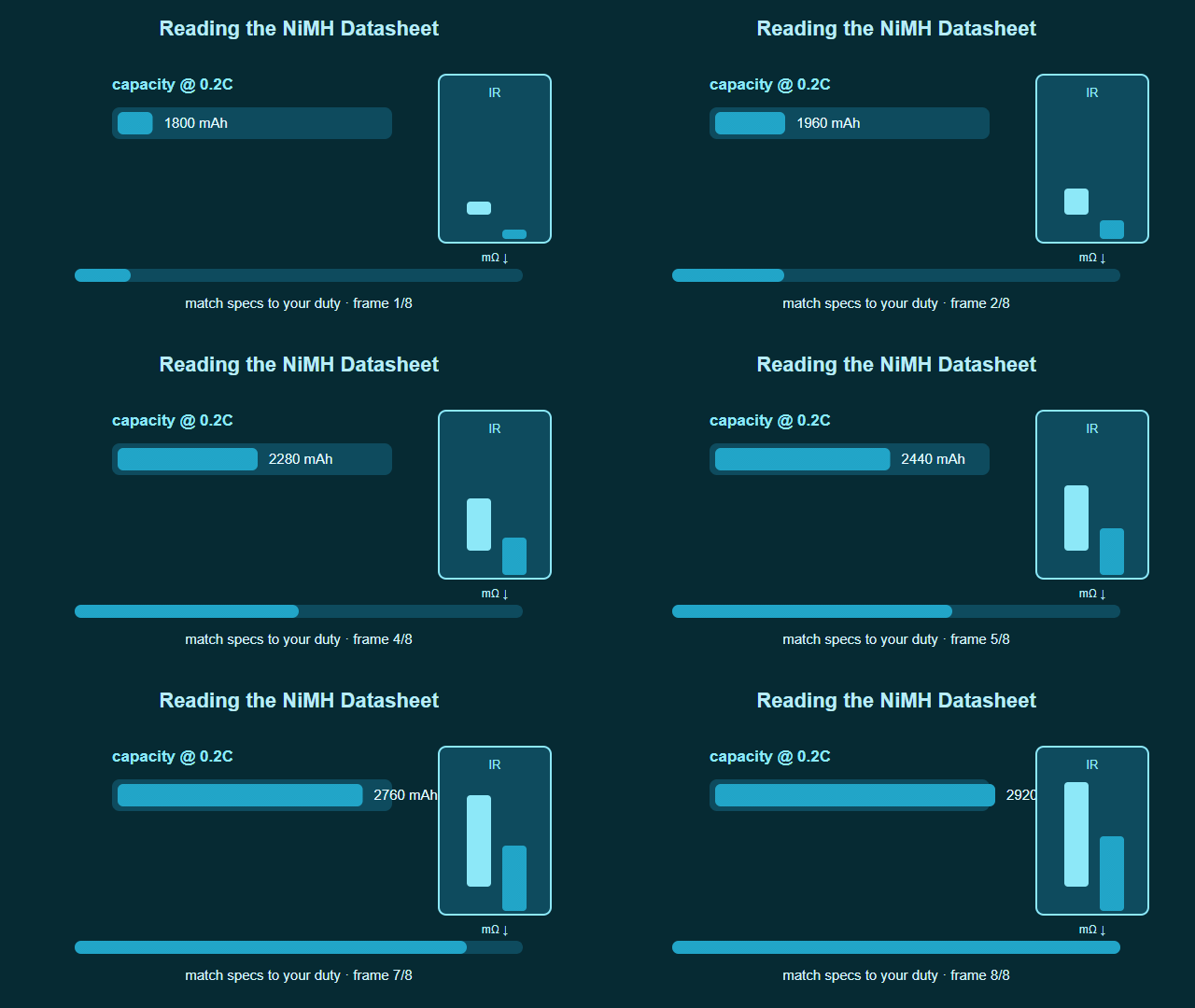
The headline "capacity" (in mAh or Ah) is measured under specific, standardised conditions — and those conditions may not match your product. Capacity is rate-dependent and temperature-dependent:
- The C-rate matters — a cell rated 2500 mAh at a low 0.2C discharge will deliver meaningfully less at a high 1C or 2C drain. A datasheet should show a capacity vs discharge-rate curve; the "rated" number is only one point on it.
- Discharge curves — the voltage-vs-time (or voltage-vs-capacity) discharge curve shows the cell's voltage plateau and its cut-off. A flatter plateau means steadier voltage through discharge; a sagging curve means poor high-rate behaviour.
- Temperature matters — capacity is usually quoted at 20-25°C. Cold reduces it (see the low-temperature story); hot operation ages it faster. Always check whether the rated number assumes room temperature.
Internal Resistance: The Spec That Predicts Real-World Punch
Internal resistance (IR), quoted in milliohms, governs how much voltage sags under load and how much heat the cell generates. It is the single best predictor of high-drain performance:
- Low IR = strong punch — low internal resistance means less voltage drop under a power burst, which is why low-IR cells win in power tools, cameras and high-rate applications.
- AC vs DC resistance — datasheets may cite AC (1kHz) or DC resistance; they measure slightly different things. DC resistance under load is usually more relevant to real discharge behaviour.
- IR rises with age and temperature — a fresh cell's low IR is not the whole story; check how IR degrades over cycle life, because a pack with rising IR loses usable power long before it loses nominal capacity.
Self-Discharge: The Silent Drain
All rechargeable cells lose charge while sitting idle, but NiMH's natural self-discharge used to be relatively high. That changed with low self-discharge (LSD) cells, which retain 70-85% of their charge after a year of storage. If your product sits on a shelf, in a drawer, or in an emergency kit before use, self-discharge may matter more than peak capacity:
- LSD NiMH — ideal for standby, emergency and consumer products that may go months between uses; charge once and it largely stays.
- Read the retention figure — look for "charge retention after X months" (e.g., 80% after 12 months) and check the storage temperature assumption.
Cycle Life: How Many Times Can It Live?
Cycle life is the number of charge/discharge cycles until the cell reaches a defined end-of-life (commonly 60-80% of initial capacity). A few nuances:
- Depth of discharge changes it — a cell cycled gently at 30-50% depth lasts far longer than one deep-cycled to 100% every time. Datasheet cycle life is usually quoted at a specific DoD; know yours.
- Rates and temperature affect it — fast charging and high temperature accelerate ageing. The cycle figure assumes a specified charge/discharge regime.
- Rated vs real — a premium cell rated 1000 cycles at 100% DoD may deliver thousands of shallow cycles; a cheap cell may degrade far faster than its label suggests. Ask for the test method.
Standards Give the Numbers Meaning
Reputable NiMH cells are tested against international standards, most importantly IEC 61951-2 (rechargeable nickel-metal hydride cells) and related safety standards. Compliance with IEC, CE, RoHS, REACH and UN38.3 (transport) tells you the cell was tested under defined, reproducible methods — which is what makes a datasheet's numbers meaningful. A datasheet with no test standard behind it is a sales sheet, not a specification.
Matching Specs to Your Application: A Quick Cheat-Sheet
- High-drain / power tool — prioritise low internal resistance, high C-rate discharge, strong voltage plateau. Capacity-per-gram matters less than punch.
- Standby / emergency / remote — prioritise low self-discharge (LSD), reliable charge retention, wide temperature tolerance. Peak capacity matters less than staying ready.
- Everyday consumer / toy / remote control — balance capacity, self-discharge and cost; consistency across cells in a set matters for multi-cell devices.
- Industrial / pack application — prioritise matched grading (consistent capacity/IR across cells), cycle life at your real DoD, and documented traceability.
Ask the Right Questions Before You Buy
- Is rated capacity quoted at 0.2C, and what does it deliver at my real discharge rate?
- What is the internal resistance, and how does it degrade over cycle life?
- What is the self-discharge retention, and after how many months at what temperature?
- Cycle life is quoted at what depth of discharge and what charge/discharge rates?
- Are the figures backed by IEC 61951-2 testing, and do you have the test data?
- Are cells in a multi-cell pack matched by capacity and internal resistance?
The Datasheet Is Only as Honest as the Test Behind It
A good NiMH datasheet is a window into how the cell was made and tested. Read it for the conditions behind the headline numbers, not just the numbers themselves. When a supplier publishes discharge curves, IR degradation data and the test standards behind its ratings, you can specify with confidence — and avoid the unpleasant surprise of a cell that looks great on paper and disappoints in the product.
Weijiang Power, Data You Can Specify Against
Weijiang Power publishes NiMH capacity, discharge, internal-resistance, self-discharge and cycle-life data with the test methods behind them, and grades cells for matched packs. If you are evaluating a cell or comparing suppliers, share your application, discharge profile and duty — we will help you read the datasheet that fits your product and back it with the data that matters.
Series · NiMH Engineering Deep-Dives
Related Reading


